

Most common and widely used gauges
12-gauge
The most popular and versatile. Uses: big and small game hunting, trap shooting, self-defense, and buckshot or slug ammunition.
20-gauge
Very popular for small game hunting and recreational shooting: less recoil than a 12-gauge, good power for birds and rabbits, comfortable for smaller shooters.
16-gauge
Less common today, but appreciated by hunters who want a middle ground between 12- and 20-gauge. Good performance in bird hunting.
28-gauge
More "delicate": mainly used in sport shooting and small bird hunting due to its low recoil and good accuracy with fine shot.
.410 bore
Very light, used for training, pest control, and small game hunting in confined spaces.
These are the most common gauges used by hunters worldwide, but each gauge has its variation depending on the chamber size.
What is the chamber?
The chamber is the cavity in the firearm where the cartridge is housed before firing; its nominal length (e.g., 2¾", 3", or 3½") indicates the maximum length of the cartridge in the open position that the shotgun accepts.
Common lengths and equivalences
· 2¾" (≈70 mm) — historically the most common.
· 3" (≈76 mm) — very common in modern models and for more powerful loads.
· 3½" (≈89 mm) — "magnum" chambers (big game/waterfowl)
Each gauge could be chambered in all 3 sizes. For example: Just as there is a 12/70 gauge with a 70mm chamber, a 12/76 with a 76mm chamber, and a 12/89 with an 89mm chamber, in theory the other gauges could also be chambered in all sizes: 20/70, 20/76, 20/89, 16/70, 16/76, 16/89, etc. However, in practice, not all gauges are chambered in all sizes.
Compatibility and safety
· Safe: Firing shorter cartridges in a longer chamber (e.g., 2¾" in a 3½" chamber) is usually safe from a pressure standpoint, though it may cause feeding or extraction problems in semi-automatics.
· Danger: Never insert a cartridge that is longer than the chamber (e.g., 3" or 3½" in a 2¾" chamber): this can greatly increase pressure and damage the firearm or cause injury.
The barrel bore
The barrel bore is the interior part of the shotgun tube through which the projectile travels when fired. There are two main types of bore:
· Smooth bore: Characteristic of shotguns. It allows the use of cartridges loaded with shot or buckshot, which causes the ammunition to disperse after firing.
· Rifled bore: Present in rifles and pistols. It has grooves inside that cause the projectile to spin, increasing accuracy.
In the specific case of shotguns, the diameter of the bore determines the gauge, following the traditional system based on the weight of lead.
How shotgun gauge is calculated
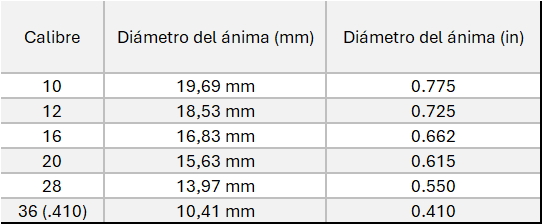
The gauge number is determined by the number of lead spheres of the same diameter as the barrel bore that can be obtained from one pound of lead (453.59 grams). Thus, the number indicates how many spheres of that size can be made from 0.453 kg. For example, for a 12-gauge, 12 spheres of the bore's diameter (approximately 0.725 inches or 18.5 mm) are obtained from one pound of lead.
Table of gauges and bore diameters
The special case of the .410 gauge
The .410 gauge constitutes an exception to the traditional system, as it is not based on the number of lead spheres obtained from a pound, but rather its measurement corresponds to inches. Specifically, .410 indicates that the bore diameter of the barrel is 0.410 inches, equivalent to 10.41 mm. Technically, the .410 gauge would be approximately equivalent to a 67-gauge if the traditional system were applied. It is considered a low-power cartridge, frequently used in small game hunting, sport shooting, and by beginners due to its lower recoil. Additionally, in some countries, it is known as 36-gauge, given the similarity of its diameter to that of 36-gauge shotguns in the European metric system. Although the naming convention differs, both gauges can be considered equivalent in practice.
Conclusion
In summary, the smaller the gauge number, the larger the barrel diameter and the greater the powder and shot load. Conversely, a larger number implies a smaller diameter and, generally, less recoil. The .410 gauge is an exception, as its measurement is expressed in inches and does not follow the traditional lead-pound system. Ultimately, the internal diameter of the barrel bore is the determining factor in gauge classification and defines the size of cartridges that the shotgun can use.


