
Ruger LC CARBINE™ 19300
Approx. Price: 0€
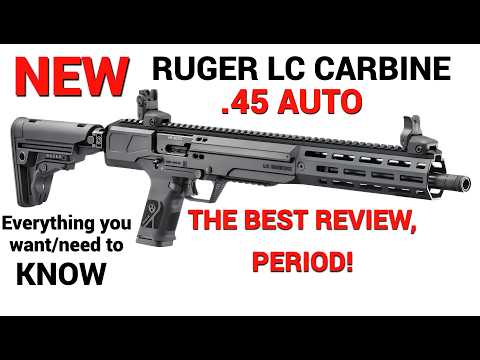
The standard model includes a threaded barrel, a reversible, side-folding and adjustable stock, and a 20-round magazine.
Weighing less than 2.7 kg (6 lbs), the lightweight and compact Ruger® LC Carbine™ uses the same steel magazines and familiar ergonomic controls as the Ruger-5.7® pistol.
Its unique bolt-over-barrel design, with the magazine integrated into the grip, allows for excellent balance and control.
The folding and reversible stock, as well as the retractable sights, are ideal for storage.
It features a 16.25-inch rifled steel barrel, treated with nitride, for added strength, accuracy, and durability.
A Picatinny rail on the rear of the receiver allows for maximum accessory compatibility.
The 1/2"-28 threaded barrel with thread protector allows for the attachment of popular muzzle accessories, such as muzzle brakes, flash hiders, and silencers suitable for the caliber.
Impressive ergonomics with ambidextrous manual safety, reversible charging handle, ergonomic bolt release and extended magazine release.
It utilizes Ruger's safe, reliable, and proven Secure Action™ trigger control system, which combines a protected internal hammer with a blade-type safety trigger. The trigger has a short, smooth travel, a clean shot, and precise reset.
CNC-machined handguard, made from Type III hard-anodized aluminum for maximum durability, with M-LOK accessory mounting slots. Multiple QD mounts.
for straps that offer maximum versatility.
Ruger® Rapid Deploy folding sights are adjustable for windage and elevation, and the full-length Picatinny rail allows for the mounting of optical sights.
Its safety features include: an ambidextrous 1911-style manual safety; an integrated trigger safety; a light firing pin; a neutral balance sear with significant engagement and strong spring tension; and a hammer stop to prevent the hammer from contacting the firing pin unless the trigger is pulled.
Also included: a Ruger-5.7® steel pistol magazine, an M-LOK QD sling adapter, and hex keys for disassembly.

Firearm configuration
Technical data
BrandRuger
ModelLC CARBINE
SubmodelLC CARBINE™ 19300
Type of firearmRifle
Sub-type of firearmSemi-automatic
CategoryTactical
Availability
Discontinued
HandednessAmbidextrous
Accuracy gurantee
—
Interchangeable Barrel
NO
Barrel Diameter (mm)—
Barrel Diameter (inches)—
Thread
YES
Barrel fluted
NO
Muzzle brake
NO
Barrel FinishBlack steel
Barrel MaterialSteel
Barrel Brand—
Type of stockTactical
Stock MaterialSynthetic
Fullstock
NO
Stock finishingBlack
Fire mechanismStriker
Trigger typeSingle-stage
Adjustable trigger
NO
Removable Magazine
YES
Open sights
YES
Choke
—
Type of choke—
Number of chokes—
BasesPicatinny Rail
Optics—

Where to buy?
Gunloupe
Rifles: Longitud cañones y la velocidad

La longitud del cañón no determina la precisión intrínseca de un rifle, sino que establece un equilibrio mecánico entre la velocidad del proyectil y la rigidez del metal. Un cañón largo optimiza el aprovechamiento de los gases de la pólvora, lo que incrementa la velocidad de salida de la bala y estabiliza su trayectoria a largas distancias al resistir mejor el viento. Por el contrario, un cañón corto ofrece una estructura naturalmente más rígida que reduce las vibraciones armónicas al disparar, además de hacer que el arma sea notablemente más ligera y maniobrable. En el tiro de alta precisión moderna, los cañones cortos y gruesos suelen ser sumamente consistentes en distancias cortas y medias. Por esta razón, la elección de la longitud ideal no busca maximizar la puntería por sí sola, sino adaptar el rendimiento balístico del cartucho al entorno específico, ya sea la agilidad necesaria en la caza o la velocidad requerida en el tiro deportivo de largo alcance.
Read article

Rifles: Longitud cañones y la velocidad
Rifles: Longitud cañones y la velocidad
BALLISTICS OF CARTRIDGES FOR STAGS DURING THE RUT

The energy analysis shows the enormous difference between needing a cartridge for a red stag at 150 metres and wanting to retain a 2,000 J reserve at 500, 600 or 700 metres. At conventional hunting distances, standard cartridges continue to provide everything required. Magnums begin to justify their greater velocity, recoil and powder consumption as distance increases. But the most important conclusion does not appear in any table: the goal is not to choose the most powerful cartridge, but the one that retains sufficient energy and terminal velocity at the maximum distance at which we can genuinely place the shot accurately.
Read article

BALLISTICS OF CARTRIDGES FOR STAGS DURING THE RUT
BALLISTICS OF CARTRIDGES FOR STAGS DURING THE RUT
WALTHER RS3: INNOVATION

The Walther RS3 is interesting precisely because it does not attempt to be merely another competitor in the straight-pull hunting-rifle category. Its proposition goes considerably further. Walther has moved much of the mechanism rearward, integrated the magazine into that new layout, built the platform around a machined aluminium monocoque and positioned the center of gravity close to the shooter’s hands. The manual cocking system, optics interface and silencer concept have then been developed around that architecture.
Read article

WALTHER RS3: INNOVATION
WALTHER RS3: INNOVATION
6.5 CREEDMOOR +PEAK: FEATURES AND COMPARISON

Perhaps the most interesting thing about the 6.5 Creedmoor +Peak is not deciding whether it outperforms the 6.5 PRC, but what it represents technologically. The 6.5 PRC follows the traditional evolution: a larger capacity case allows for higher velocity. The +Peak proposes maintaining the dimensions of an extremely popular cartridge and achieving a leap in performance through new materials capable of operating at much higher pressures.
Read article
